Rotterdam: City of Architecture
The story of Rotterdam, its history, the bombing, and the reconstruction, reveals the city's fertile ground for bold architecture. When everything is lost, why not rebuild on a grand and impressive scale? The courage displayed in both design and the commissioning of architects is evident throughout Rotterdam.

A city center full of diverse architectural styles
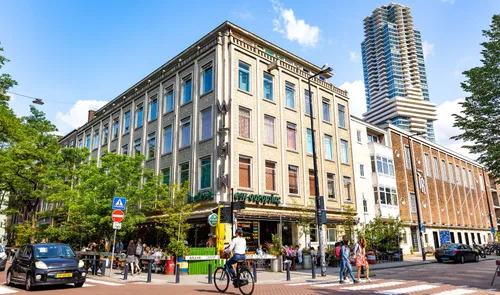
The destruction of Rotterdam’s city center in 1940 resulted in the patchwork of architectural styles you can now discover there. Here, icons of the New Architecture (Huis Sonneveld, Van Nelle Factory) and typical post-war architecture (The Industry Building, Rotterdam Bank) shine alongside hyper-modern residential towers (De Rotterdam, Zalmhaven Tower, and The CoolTower). It is precisely this variety that tells the story of the city. The city where, during a walk through the city center, you will also encounter monuments like the Town Hall, Laurens Church, and the Schielandshuis: the relics of former Rotterdam. And even Europe’s first skyscraper – the 45-meter-high White House from 1898 – survived the bombing. Right next to Laurens Church stands the Markthal, which tells its own story and ushers in a new Rotterdam era.
New Building
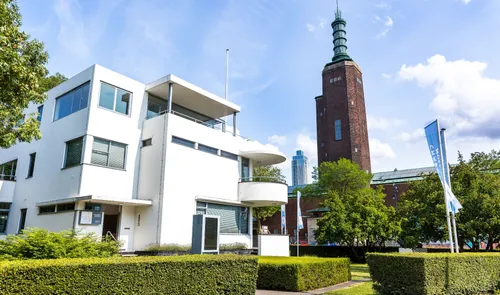
However, Rotterdam was already a progressive city in terms of architecture before the bombing. Especially in the field of housing, the city was at the forefront of innovation. Among other things, with the Bergpolderflat by Van Tijen (the first Dutch gallery flat), the Cube Houses by Piet Blom, and the Justus van Effen block by Michiel Brinkman, which for the first time included various shared facilities for residents and a revolutionary ‘upper street’. But the aforementioned New Building had already made its entrance in Rotterdam before the war, under the influence of the Bauhaus school and movement. Its principles? The search for simplicity and functionality. City architect J.J.P. Oud (of, among others, De Unie) shaped the connection between the Bauhaus and Rotterdam. His social housing projects in Spangen, the Kiefhoek, the White Village, and Hoek van Holland attracted the attention of German architects, and his lecture in 1923 marked the beginning of intensive contact between the German school and the ‘New Building’ in Rotterdam, as the movement in architecture is called.

Good and Green Living Environments
The Van Nelle Factory (1925), now visitable in combination with the Chabot Museum, is considered the main industrial monument of this and has been on the UNESCO World Heritage List since 2014. Many architects later referred back to the pre-war innovations in Rotterdam’s social housing. One of the first projects by architect Francine Houben (Mecanoo) is a good example of this. As early as 1989, she designed the Ringvaartplasbuurt-Oost as a new type of garden city, where gardens and shared outdoor spaces played the leading role. She built on the then progressive garden villages that arose in Rotterdam, of which Tuindorp Vreewijk is the most famous. Creating good and green living environments for the Rotterdam workers, that was the idea behind it. You can still see this in the neighborhood and step into the Rotterdam past when you visit the museum house in Vreewijk. The greenery that Mecanoo reserved in 1989 was rare at that time. But it did earn this project the very first sustainability award.
Spatial Rotterdam
By breaking with the past and choosing a spacious layout and modern architecture during the reconstruction, Rotterdam acquired its current, spatial look. Light, air, and space became the motto. You can see this, for example, on the Lijnbaan, the Netherlands' first car-free shopping promenade. But also in the concert hall (and national monument) De Doelen, the Groothandelsgebouw, the Euromast, and De Bijenkorf, which also emerged in this period. A counterreaction to this could not be avoided. It came in the 1970s, when more small homes were built in the city according to the "human" scale. The previously mentioned Cube Houses are the result of this. In the next phase, Rotterdam went upwards: high-rise buildings broke through and steadily formed the now characteristic skyline of the city. With the arrival of the Erasmus Bridge, more activity – and new construction – began on the Kop van Zuid, with Montevideo, the Maastoren, and New Orleans. Gradually, Rotterdam South became an integral part of the city, and the Erasmus Bridge and monumental Maastunnel became must-sees and gateways to new developments in the city. Such as in Katendrecht with Theater Walhalla, Fenix I, the Fenix Food Factory, and many cultural programs. Or with all the developments in the Afrikaanderwijk and Heart of South. Too many to mention!

We continue to innovate!
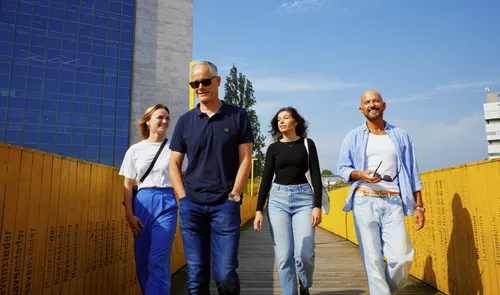
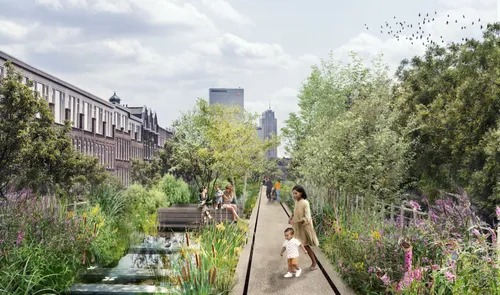
The drive to innovate is still alive and kicking in Rotterdam! A lot is happening in the Central District of the city. For example, the architectural firm ZUS saved the Schieblock from demolition and transformed it into a vibrant business complex with a real RoofFarm. Via the bright yellow Luchtsingel – the bridge that connects the city center with the North – you walk to the Luchtpark Hofbogen, a park on the former train station. The entire route of De Hofbogen is being transformed into a green and lush elevated city park, almost two kilometers long! In the same neighborhood, work is underway on the new development of ZOHO (the Zomerhofkwartier), where residents, entrepreneurs, and creators will soon live, work, and thrive together.
Innovative Architecture
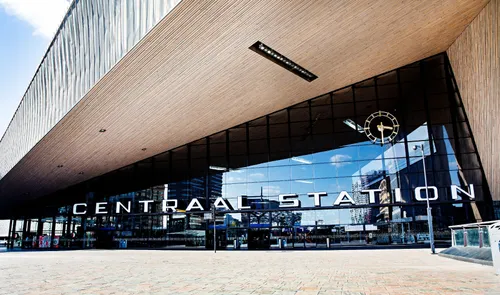
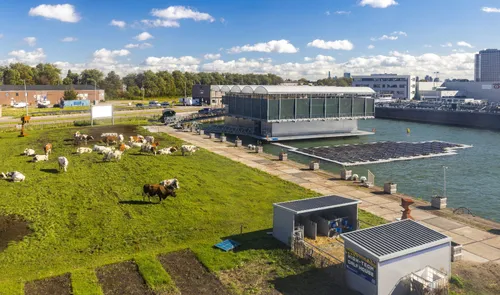
The piles are still ringing here, and in the past decade, Rotterdam has gained a few 'new icons', such as Rotterdam Central Station, the Markthal, De Rotterdam, the Timmerhuis, and the Depot Boijmans Van Beuningen. Rotterdam is never finished. Even the construction cranes are an integral part of the skyline. From the New Building and post-war reconstruction to high-rise buildings, the city is now also in the phase of innovative and climate-adaptive architecture. Because cities worldwide are struggling with the consequences of climate change, standing still and doing nothing is not an option. And the people of Rotterdam are certainly not good at that... Initiating, learning, anticipating, and innovating seems to be in the blood of the people here. How do you see this reflected? One place where the green development of Rotterdam is already clearly visible is the Rijnhaven: the testing ground for floating construction, with the spectacular Floating Office (by Powerhouse Company) as a major attraction for architecture enthusiasts. The building is entirely made of wood, self-sufficient, sustainable, and floating! Meanwhile, a floating city park is rising around it, with lawns, trees, plants, and an actual city beach. A hot summer day? Here, you can dive straight into the Maas River! Floating homes (Havenlofts) and a floating farm (Floating Farm) have already been realized in Rotterdam. Water is not a hindrance here but is utilized because the people of Rotterdam simply consider it another type of ground to build on.
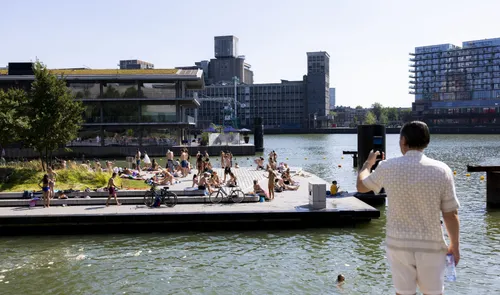
Climate-Adapted Design
Even in other parts of the city, a lot of work is being done on climate-adaptive measures by addressing the outdoor spaces. With features such as water plazas, wadi’s, green roofs, and less stone, the city is better equipped to handle heat, drought, and heavy rainfall. By consistently and generously investing in innovation, Rotterdam is one of the frontrunners in the field of climate adaptation. The aforementioned Hofbogenpark is also being designed with climate-adaptive measures by DE URBANISTEN, DS landscape architects, and the Dakdokters. It will soon be maximally cooling, offer shelter, and absorb CO2 and water. This park is one of the seven city projects through which Rotterdam is focusing on a greener, sustainable living environment.
Greening and Sustainability
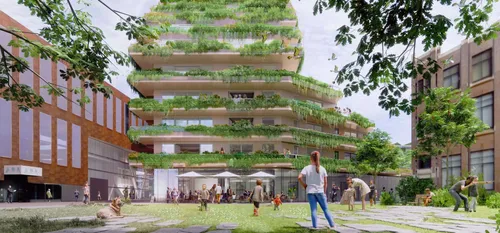
Although this sustainable goal seems to conflict with the ambition to build no less than 50,000 homes by 2040, Rotterdam architects turn a necessity into a virtue. Firms like MVRDV, Powerhouse, Superuse Studios, LOLA landscape, and Mei architects and planners are working with great ambition. The goal is not ‘just’ sustainable building, but regenerative building: not only limiting the damage caused by construction but adding value in all areas. SAWA illustrates this design approach. SAWA is rising on the Rotterdam Lloydpier and is sustainable, as it is built from wood, which stores CO2 rather than emitting it. It is circular and even remontable; the materials can be reused. Additionally, a well-thought-out green concept has been developed with an ecologist, featuring private outdoor spaces and a communal vegetable garden. In addition to building out of necessity or following a prevailing style, Rotterdam is now determinedly working on a pleasant, green, and healthy residential city. Greening and sustainability make the living environment more pleasant, after all.
Architecture of the Future
The architectural diversity continuously invites new architects and designers to contribute. The positive spiral of stimulation and inspiration logically continues into the future. The first signs of this are already visible. In line with the sustainability concept, a number of historical buildings are being transformed. They are given a new purpose, and thus partly a new appearance, through extensions or additions, beautifully illustrating the fusion of Rotterdam's history and innovation. This applies to the Boijmans Van Beuningen Museum, the old Post Office on the Coolsingel, and also to the Fenix Sheds II. Here, FENIX is being realized, a place where art, history, and stories come together at the site where emigrants once arrived and departed. After an intensive renovation, the pre-war warehouse will receive a spectacular extension and also a viewpoint, which in itself will be reason enough for a visit.

BlueCity and M4H: Breeding grounds for innovation
Breeding Grounds for Innovation. With the boldness and experimental spirit with which Rotterdam built its city center, the city is now tackling the climate challenge. Architects, designers, and scientists are encouraged to collaborate on innovative ideas. For example, the former tropical swimming paradise Tropicana was transformed into BlueCity, a model city for the circular (blue) economy. It provides workshops and laboratories for startups like Waterweg, which develops permeable tiles, and BlueBlocks, which produces biobased construction materials. Also, on the old harbor sites M4H and RDM, which together form Rotterdam’s new makers district, work is in full swing on innovations at the intersection of art, design, and technology.
Playground for Creators
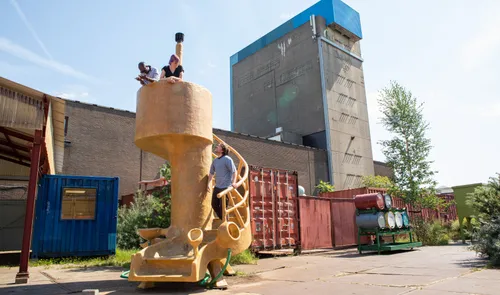
The fact that creatives are continually given (and take) the space to innovate is also proven by artist Joep van Lieshout. In collaboration with architect and developer Nanne de Ru (Powerhouse & RED Company), he is building BRUTUS in M4H. This cultural center, at least 7,000 m² in size, houses exhibition spaces, a labyrinth, places for workshops and education, studios, live-work spaces for artists, and a sculpture garden in the outdoor area. This 'artist-driven playground' puts creators at the center and guarantees them – regardless of gentrification – a place. This is also a sustainable thought, as it contributes to the preservation of Rotterdam's creative and innovative mentality.
Are you heading into the city with the Discover Rotterdam brochure or joining an architecture tour by, for example, UrbanGuides? Either way, don’t miss out on these 10 must-sees (mostly architectural)!
Top 10 Must-Sees and Sights
Rotterdam offers an abundance of sights, and there is always something new to discover in the city. Especially in the field of architecture, there is much to admire. In this top 10 of must-sees, you will therefore find many architectural highlights, such as the Boijmans Van Beuningen Depot, the Cube Houses, and the Euromast.