Bauhaus in Rotterdam
Bauhaus was a revolutionary school of art and design that had a lasting influence around the world, including on the architecture of Rotterdam. Its principles of simplicity and functionality can be seen in iconic buildings such as the Van Nelle Factory and Huis Sonneveld. The residential area the Kiefhoek is also an example of Bauhaus ideals in Rotterdam, closely linked to the Dutch architectural movement known as Nieuwe Bouwen.
What is Bauhaus?
The Bauhaus was founded in 1919 by architect Walter Gropius in the German city of Weimar. What began as an academy for architects, artists and industrial designers quickly grew into one of the most influential movements in modern art and design.
At the heart of Bauhaus thinking is the principle that form follows function. This led to practical buildings and everyday objects designed for modern life. The style is characterised by geometric shapes, clean lines and little to no decoration. The use of modern materials such as glass, concrete and steel is also typical. The influence of Bauhaus can still be seen today in contemporary art, architecture and design.
Affordable design for everyone
At a time when art and design were largely accessible only to a small, privileged group, Bauhaus envisioned a world in which good design would be available to everyone. Making beauty and functionality affordable was a core ambition. This ideal, combined with new ways of thinking about art and design, had a major impact worldwide. In the Netherlands, these ideas found fertile ground in modern architecture, particularly in future-focused Rotterdam.
 Iris van den Broek
Bauhaus and Rotterdam
Rotterdam’s connection to Bauhaus is closely linked to the work of city architect J.J.P. Oud. His social housing projects in Spangen, the Kiefhoek and Het Witte Dorp attracted the attention of German architects. In 1923, Oud gave a well-known lecture that marked the beginning of a productive exchange between the Bauhaus school and Rotterdam.
Oud’s projects are examples of Nieuwe Bouwen, a Dutch architectural movement that developed alongside Bauhaus. The two are often compared because they share the same modernist principles. Nieuwe Bouwen stood for functional, socially minded and aesthetically responsible architecture, expressed through clean designs and the use of concrete, glass and steel. This approach fits Rotterdam well, a city known for its openness to experimentation and renewal.
In 2019, the world celebrated 100 years of the Bauhaus, the revolutionary art and design school that continues to shape architecture, design, and art worldwide.
 Iris van den Broek
Bauhaus icons in Rotterdam
The influence of Bauhaus and Nieuwe Bouwen is still clearly visible in Rotterdam today. These modernist landmarks show how strongly the movement shaped the city.
Van Nelle Factory (Van Nellefabriek)
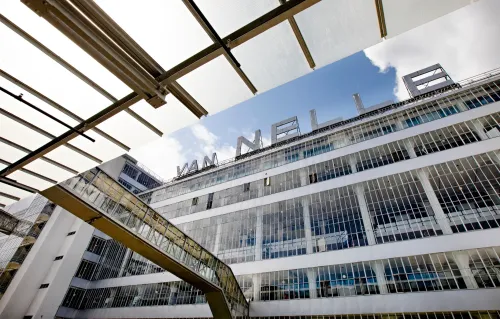
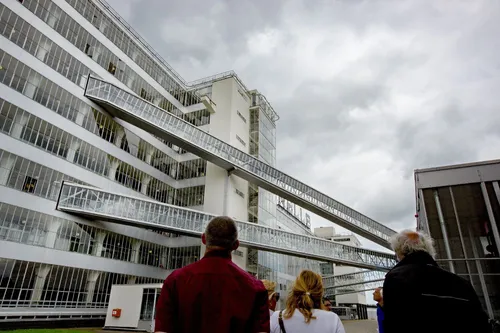
Designed by Leendert van der Vlugt of the architectural firm Brinkman & Van der Vlugt, the Van Nelle Factory is a masterpiece of modern architecture. The building perfectly reflects Bauhaus principles such as simplicity, functionality and transparency.
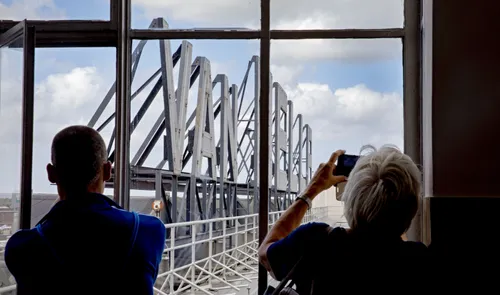
Built in the 1920s, the factory is known for its innovative use of steel, glass and concrete, making it one of the most important examples of modern industrial architecture. In 2014, the Van Nelle Factory was added to the UNESCO World Heritage List. You can visit the site on guided tours organised by the Chabot Museum, which runs walk-in tours every weekend for anyone interested in modernist industrial architecture.
Guided tours Van Nelle Factory (Van Nellefabriek)
Would you like to visit the Van Nelle Factory? You can do so with guided tours by Urban Guides and the Chabot Museum. Every weekend, the museum organises open tours for anyone interested in modernist industrial architecture. Visiting with a group? Urban Guides offers guided tours seven days a week.
Huis Sonneveld
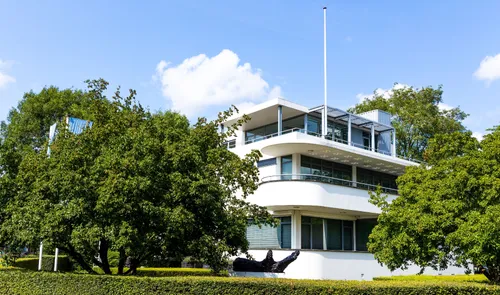
In 1929, Albertus Sonneveld, one of the directors of the Van Nelle Factory, commissioned Brinkman & Van der Vlugt to design a detached family home. With its clean lines and open layout, Huis Sonneveld is a fine example of Nieuwe Bouwen.
The interior was also designed by the architects, working closely with furniture designer Gispen. Huis Sonneveld is a listed monument and has been open as a museum house since 2001. An audio tour offers insight into how the family lived here in the early 1930s. The house is part of the Nieuwe Instituut, where you can buy individual tickets or a combined admission pass.
 Johannes Schwartz
Chabot Museum
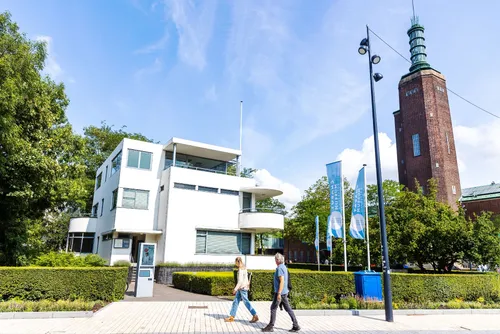
Another striking white villa stands in Museumpark: the Chabot Museum. Built in 1938, the house is also an icon of Nieuwe Bouwen. Its open design, clean lines and large windows reflect modernist principles closely linked to Bauhaus thinking.
Today, the bright and spacious rooms are ideally suited to their current function. The museum presents the work of Rotterdam painter and sculptor Henk Chabot, alongside temporary exhibitions of international expressionism.
De Kuip
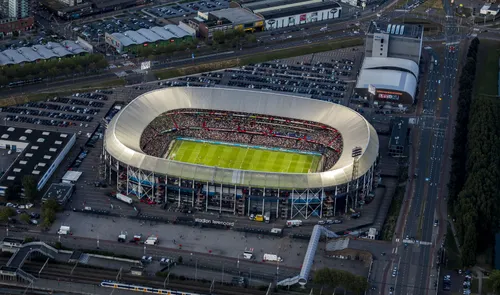
Another Rotterdam icon by Brinkman & Van der Vlugt is Stadion Feijenoord, better known as De Kuip. The design incorporates many key principles of Nieuwe Bouwen, including a visible structure of steel and concrete. Practical use comes first here: everything you see serves a purpose.
You can experience De Kuip during football matches and other events, or join a stadium tour where a guide takes you behind the scenes of this iconic building.
 Guido Pijper
Kiefhoek
In Rotterdam-Zuid lies the residential area of Kiefhoek, a highlight of modernist social housing. Architect J.J.P. Oud gained international recognition through the design of this neighbourhood. The area consists of 294 family homes, all based on a standard floor plan, making construction efficient and affordable.
Inside, the homes featured smart design solutions such as built-in cupboards, a coat rack and a hat shelf. Curious to learn more? UrbanGuides offers guided walking tours through the Kiefhoek, starting at the museum house on Hendrik Idoplein. This house can only be visited with a guide, except during Open Monument Day and Rotterdam Architecture Month, when it is also open to individual visitors.
Woonblok in Hoek van Holland
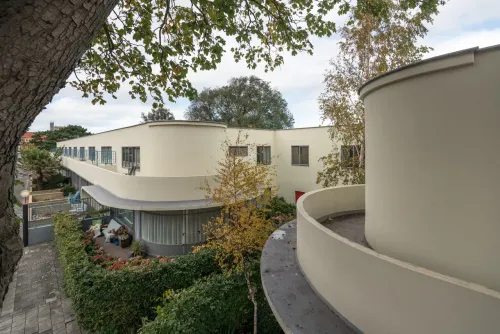
J.J.P. Oud also designed affordable workers’ housing in Hook of Holland during the 1920s. The housing block on Tweede Scheepvaartstraat features white plastered façades with rounded corners, where shops were originally located. Here too, modernist principles are clearly visible: simplicity, functional design and a clear overall composition.
Kralingse Plas
Even during a walk around the Kralingse Plas, you will encounter buildings inspired by Bauhaus principles. One notable example is the villa of Kees van der Leeuw, one of the directors of the Van Nelle Factory. He commissioned Brinkman and Van der Vlugt to design his private residence.
The clubhouse of the Rotterdamsche Zeilvereniging and the Kralingsche Manege complex also feature modernist designs by architect Van Tijen. He was also responsible for the Plaslaanflat, designed in the style of Het Nieuwe Bouwen.
As you make your way further into the Kralingse Bos, another modernist icon can be found: the clubhouse of Golfvereniging Kralingen, designed by Van der Vlugt.
Top 10 Museums and Art Spaces
In Rotterdam, diversity isn’t just on the streets, it’s reflected in the city’s vibrant mix of museums and cultural spaces. From visual arts and photography to architectural heritage and modern themes, there’s so much to explore.