Unconventional Art on the Streets
From giant feet and foxes to Santa Claus, Rotterdam’s outdoor art grabs your attention. Each piece tells a story or carries a message from a passionate creator. Over the years, the city has embraced striking, experimental works that are as innovative, diverse, and thought-provoking as Rotterdam itself. Explore 12 unique examples!

1. Moments Contained by Thomas J. Price (2022)
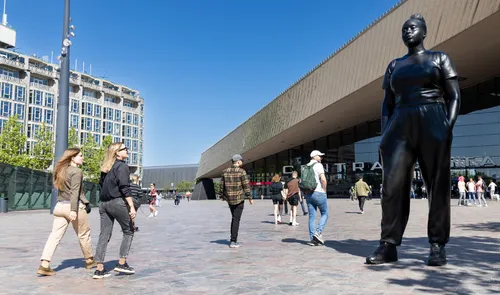
The sculpture Moments Contained at Rotterdam Centraal is an impressive bronze figure of a fictional, anonymous young woman. With her confident posture and the knuckles of her clenched fists visible in her pockets, the statue suggests an inner tension that is not immediately apparent. Unlike traditional statues, she does not stand on a pedestal but directly on the ground, establishing a direct connection with the surroundings and viewers. The title Moments Contained refers to holding back emotions, according to artist Thomas J. Price. The piece raises questions about who in society deserves to be honored with a monument. Public sculptures have often been reserved for powerful men, but this artwork seeks to ignite a conversation about who deserves visibility and representation. The artist describes the portrayed woman as stoic, resilient, and vulnerable, making her a complex and intriguing figure.
 Iris van den Broek
2. Erasmus by Hendrick de Keyser (1622)
Sculptor Hendrick de Keyser (1565 – 1621) designed this statue of Desiderius Erasmus based on painted portraits and drawings. In these portraits, Erasmus is often depicted wearing a habit and the characteristic bonnet, reading with a serious expression. The statue, cast in 1622 and placed at Grotemarkt, survived the city’s bombing during World War II. Afterward, it was removed from its pedestal and hidden in Museum Boijmans Van Beuningen during the war. Today, Erasmus stands outside again.
 Iris van den Broek
3. Everyone is dead except for us (Iedereen is dood behalve wij) by Ben Zegers (2020)
Everyone is Dead Except Us is the not-so-uplifting title of this artwork unveiled in 2020 at the intersection of Binnenrotte and Hoogstraat. Coincidentally, this is the exact location where Rotterdam was founded. Artist Ben Zegers (1962) created two gigantic aluminum feet to mark the spot. Why feet? They refer to the footsteps of the first Rotterdammers and the foot position of Edgar Degas' dancer from the collection of Museum Boijmans Van Beuningen. The playful movement of the feet fits the dynamic of the market and the city. And the title? It ties the present, past, and future together in a unique way, calling for people to do something with it—together and now.
Walk a few meters further and view the artwork Hoorn des Overvloeds—a 11,000-square-meter masterpiece on the interior wall of the Rotterdam Markthal, created by artists Arno Coenen and Iris Roskam in collaboration with architectural firm MVRDV.
 Iris van den Broek
4. De verwoeste stad by Ossip Zadkine (1953)
The Destroyed City monument commemorates one of the most significant events in the city's history: the May 14, 1940 bombing. French artist Ossip Zadkine (1888 – 1967) translated this tragedy into a disoriented figure with a hole where the heart would be, symbolizing the city’s broken heart. This four-meter-tall sculpture and national monument evoke the emotions that many Rotterdammers likely felt seeing their city in ruins. It became one of the most well-known war memorials in Western Europe, a lasting reminder of what should never be forgotten. Every year on May 14, the bombing of Rotterdam is commemorated here at Plein 1940 at Leuvehaven.
 Iris van den Broek
5. De Boeg by Federico Carasso (1956)
When cycling across the Erasmus Bridge from south to north, you'll see a 46-meter-high aluminum bow rising above concrete waves at the Boompjes. This is the war monument De Boeg, unveiled in 1956. Italian artist Federico Carasso (1899 – 1969) created the sculpture in memory of 3,500 sailors from the Dutch merchant fleet who died during World War II. In 1965, an eight-meter-high bronze group was added: a helmsman, three sailors, and a drowned man. The inscription reads: "They kept course."
 Otto Snoek / BKOR
6. Santa Claus by Paul McCarthy (2001)
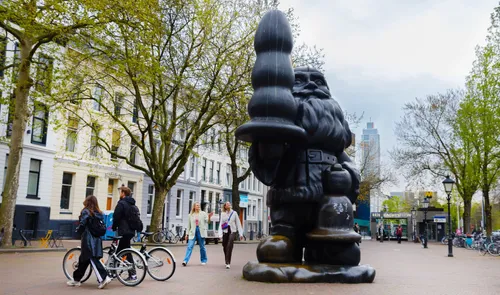
Who doesn’t know the statue Santa Claus by Paul McCarthy (1945), located at Eendrachtsplein in Rotterdam? This giant Christmas figure, holding a Christmas tree, is more famously known as Kabouter Buttplug in Rotterdam. The acquisition of the statue stirred up controversy in 2003, which is exactly what McCarthy aims to do: societal criticism with a wink. This XXL Santa delivers a critique of consumerism, and today, it has become an unintentional symbol of selfie culture, with people frequently posing for pictures on the Santa's lap.
 Iris van den Broek
7. Cascade by Atelier Van Lieshout (2010)
Strange, liquid-like figures drip from eighteen large stacked oil drums on the Coolsingel. The artwork Cascade—also known as "the dripper"—stands at eight meters tall and is impossible to miss. Created by Atelier Van Lieshout, led by Joep van Lieshout (1963), the work references both the Port of Rotterdam and the rat race many find themselves in. Van Lieshout’s dark worldview is also reflected in his long-running art project SlaveCity. The installation, and his other bold designs, push boundaries and spark conversation. It resulted in groundbreaking designs and the opening of his own housing and cultural project, Brutus, complete with Brutus Garden. The garden is always free to visit and aligns with the vision of the Atelier: here, art is available to everyone, free and always accessible, like oxygen."
 Iris van den Broek
8. Clave by Alex da Silva (2013)
In 2013, exactly 150 years after the official abolition of slavery in the Netherlands, the Clave Slavery Monument was unveiled at Lloydkade. Rotterdam’s 18th-century triangular trade between Rotterdam, Africa, and the Caribbean is symbolized here, as thousands of Rotterdammers carry a history tied to slavery. Artist Alex da Silva (1974 – 2019) designed the monument as a steel ship with dancing figures—some looking toward the past, others, free from chains, looking toward the future.
 Peter Schmidt
9. L’Âge d’Or by Gavin Turk (2021)
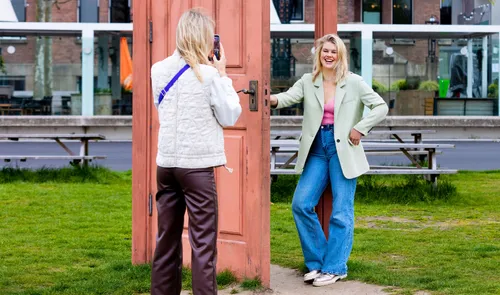
British artist Gavin Turk (1967) elevates the everyday to the level of art, as seen in L'Âge d'Or. This work, featuring a 3.5-meter-high open bronze door painted green and red, welcomes millions of travelers and emigrants who arrived or departed via the Rotterdam docks. The door symbolizes the transition between old and new worlds. It stands across from the Fenix museum, which also owns the artwork.
 Iris van den Broek
10. Bospoldervos by Florentijn Hofman (2020)
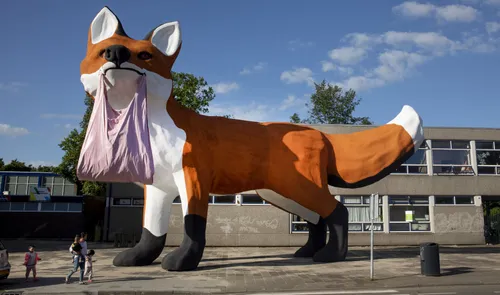
In 2020, an enormous fox, measuring 16 meters in length and 10 meters high, appeared in the Bospolder-Tussendijken district. With a large plastic bag in its mouth, artist Florentijn Hofman (1977) creates a connection between the city and nature, referencing the area's name and the increasing visibility of foxes in urban spaces. The artwork also comments on the ban on plastic bags.
 Iris van den Broek
11. Parabola Blues bby Madeleine Berkheimer (2021)
Once, prisoners walked up the stairs that now form the basis of the artwork Parabola Blues by Madeleine Berkhemer (1973-2019). The two staircases together form a V on a concrete plinth, with golden threads between them symbolizing the connection between the past and present of the location. Like the stairs themselves, the location underwent a transformation: the former prison on the Noordsingel was converted into the residential complex Tuin van Noord. After a call to artists to design something for this site, Berkhemer's sketch was chosen as the winner. The piece was developed and unveiled after her death
 Aad Hoogendoorn
12. De vlecht by Kalliopi Lemos (2021)
During a walk along the Westersingel, suddenly a braid appears. An upright, brown braid more than six meters tall. This steel sculpture was created by sculptor Kalliopi Lemos (1951), known for her large-scale public installations, and is part of the series Tools of Endearment. The cut-off braid symbolizes both change and liberation, as well as a gesture of female defiance. The sculpture was unveiled on March 8, 2021, on International Women's Day.
 Iris van den Broek
Art and design at Rotterdam galleries
Rotterdam attracts both designers and design enthusiasts. The city's raw character is a constant source of inspiration. Want to discover new, exciting work? Check out these galleries in unexpected locations, from former schools to skyscrapers!
