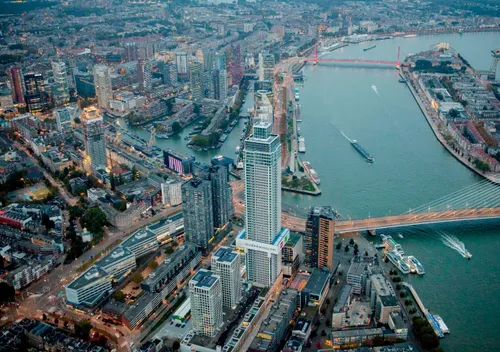
Rotterdam, city of climate-proof architecture
Rotterdam, renowned for its architecture, is leading the way in climate change adaptation with innovative projects capturing global attention.

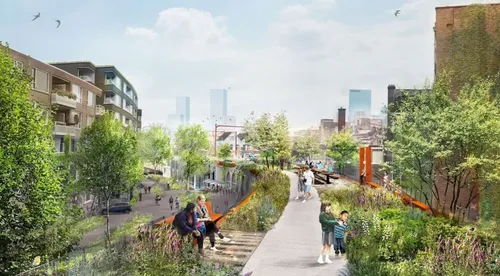
There are plans for a park to be built on the roof of the longest building in Rotterdam. And not just any park. The railway line, where trains came and went for a hundred years but which has been abandoned for the past ten, will become a lush, green two-kilometre-long oasis. This route will be home to native plants, flowers, bees buzzing, hedgehogs scurrying about, people walking and children playing. This climate-adaptive park in the middle of the city, Hofbogenpark as it will be called, was designed by DE URBANISTEN, DS landscape architects and Dakdokters. Designed to provide maximum cooling and shelter, absorb CO2 and collect water, the park will work like a sponge. Hofbogenpark is one of the city projects that Rotterdam is implementing to create a greener and more sustainable living environment.
Frontrunner
Rotterdam is drastically improving its outdoor areas in several different locations in the city by investing in city projects. Besides being green and welcoming, these have to become climate-proof. In other words: resistant to heat, drought and heavy rainfall. It is a task that cities worldwide are struggling with now that the consequences of climate change are becoming increasingly tangible. More and more of these cities are looking to Rotterdam and what is happening here. By consistently investing generously in innovation, Rotterdam is among the front runners in the field of climate change adaptation.
Render credits Hofbogenpark: DE URBANISTEN.
This will not only make the city more resilient but also a more pleasant place to live. By making the city greener and more sustainable, with more urban nature and fresh air and less paving and exhaust fumes, Rotterdam will improve the living conditions for its residents. This goes beyond creating places where it is pleasant to relax, walk, exercise and socialise. It also involves stimulating sustainable mobility, by redesigning boulevards and streets, for example.
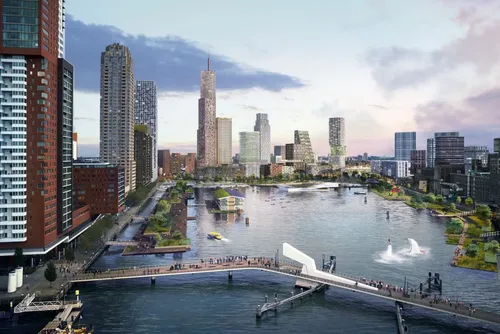
Render credits Rijnhaven: Barcode Architects.
Resilient city
It is not surprising that Rotterdam is ahead of the game when it comes to climate change adaptation. After all, Rotterdam is a low-lying delta city and, therefore, very vulnerable. That is a main reason why Rotterdam introduced the resilience strategy in 2016, which focuses on the robustness and resilience of the city.
But there is another reason: historically, and markedly since the bombing of their city in 1940, the people of Rotterdam are no strangers to hard work and getting things done. At the start of reconstruction, they chose a revolutionary path: not to repair but to completely renew. In the decades that followed, architects were given every opportunity to experiment and innovate. This can-do mentality resulted in innovative architecture that tourists still love to come to Rotterdam to admire: the Cube Houses, the Gnome Village and the very first gallery flat, and later, the Erasmus Bridge, the Market Hall (Markthal), Central Station and the Boijmans Van Beuningen Depot.
Progressive ideas
Rotterdam is now tackling the climate challenge with the same fearlessness and experimentation with which it built its modern inner city. Architects, designers and scientists are encouraged to work together to develop and test innovative ideas. For example, a group of idealists was given the key to the former tropical swimming paradise Tropicana in order to transform it into BlueCity, a model city for the circular (blue) economy. It offers workshops and laboratories to start-ups like Waterweg, which develops permeable tiles, and BlueBlocks, which produces bio-based construction materials.
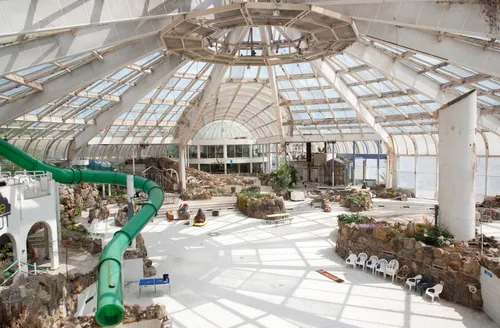 BlueCity.
The old dock areas oi M4H and RDM, which together form the Rotterdam Makers District, are also home to many innovations on the cutting edge of art, design and technology. One example is Urban Reef, a start-up that, through extensive experimentation with clay, mycelium, coffee, seeds and paper pulp, prints objects that mimic the natural habitat of plants, insects and animals. These can be used to increase biodiversity in the city.
DE URBANISTEN, who also designed the Hofbogenpark, is also involved in the redevelopment of part of the Keilehaven into a special green zone in this area, turning the stony harbour front into a tidal park with terraces of varying heights.
Adding value
Climate change adaptation is an important spearhead in the further development of the city, which plans to build an additional 50,000 homes by 2040. The need to make the city greener and bluer seems at odds with the demand for more housing. But the architects in Rotterdam are making a virtue of necessity. Agencies such as MVRDV, Powerhouse Company, Superuse Studios, LOLA landscape architects and Mei architects and planners are responding to the challenge with considerable ambition and a desire for experimentation. Their projects show that they have passed the stage of sustainable building. What they want is regenerative building: not only limiting the damage of building to man, animals and the planet, but adding value at all levels.
SAWA is an example of this design attitude; a residential building rising on Rotterdam’s Lloyd Pier that is as aesthetic as it is innovative. With this design, Mei architects and planners did not focus on one ambition but stacked several ambitions. SAWA is sustainable because it is made of wood, which means that it stores CO2 instead of emitting it. It is circular and even demountable; the building can be dismantled and the materials reused. Moreover, in cooperation with ecologists, a well-thought-out green concept was developed with private outdoor spaces and a communal vegetable garden. All that greenery stimulates biodiversity, is healthy for residents and has an important social component: you can meet others in the vegetable garden. SAWA should be completed in 2024.
Floating solutions
Rotterdam’s green development is already becoming more visible by the day at Rijnhaven. This innercity harbour is testament to floating construction with the spectacular Floating Office designed by Powerhouse Company. The building is made entirely of wood, is self-sufficient and sustainable, and floats. Also in the Rijnhaven, a series of Wikkelboats can be found, small and unique floating accommodations that can be used for a short stay or for meetings.
Life@Urban Roofs – investing in climate adaptation with multifunctional roofs
The LIFE@Urban Roofs project, funded by the European Commission’s LIFE program, aims to stimulate private investment in climate adaptation measures, especifically focusing on the use of roofs and facades. The Municipality of Rotterdam together with local partners are part of this project, supporting trials of multifunctional roofs in the city. These roofs combine various types of infrastructure, including green elements to reduce the urban heat and support biodiversity, blue elements for water storage, yellow elements for energy generation, and red elements for social use.
The project, started in 2017 and expected to run until April 2024, aims to increase green infrastructure and water storage in Rotterdam, reducing flooding risk and temperature increase and to produe sustainable, locally-generated energy. Expected outcomes include additional green infrastructure and water storage, an increase in multifunctional roofs and a blueprint for collaboration between public and private investments in climate adaptation. More information available on this website.
Header photo by Iris van den Broek.
This article was written by Elsbeth Grievink. For (re)use of (parts of) this article, please contact us.