On the road to becoming a circular city

Circularity as the norm in 2030 and a fully circular economy by 2050. These are the goals that the city of Rotterdam has set itself. With the motto ‘Van zooi naar mooi’, which translates to ‘from trash to treasure’ Rotterdam has described its circular ambitions in the municipal Program Rotterdam Circular. This program is in line with the Circular Action Plan of the EU’s Green Deal and with the national Dutch national programme Netherlands Circular in 2050 (Rijksbreed programma Circulaire Economie). Rotterdam is currently focusing on initiatives in core industries such as construction (causing 60% of the city’s waste), green streams (organic waste), consumer goods (waste collection facilities are turned into upcycling centres), and care (extracting residual matter from medicines from water for energy generation). Circular initiatives are supported with municipal and regional subsidies.
Important as these steps are, they are only the beginning of the challenging process to becoming a fully circular city. No city can achieve circularity by itself. The more open an economy is, the more circularity initiatives are interdependent. Circularity can’t and mustn’t stop at city or country borders and true circularity can only be achieved if large and complex international production cycles are aligned. But then, every journey begins with a single step. And besides the actual progress made from local developments and initiatives, they also have a strong exemplary and boosting effect.
Linear, circular, blue
What does it all mean? A brief explanation.
In the traditional linear economy goods are produced, used and discarded. Natural sources are depleted, the earth is exhausted and an enormous amount of waste is what is left when we are done with products.
In a circular economy, production and consumption processes are aligned: they form a circle with beginning and end connected and interdependent. Waste doesn’t exist, because products and resources are used again and again, in a never ending cycle. Resources aren’t depleted, products are made with reusability in mind and when they reach the end of their lifespan they’re are reused as source materials. The linear economy focuses on cycles per sector or industry, with products reused within the chain.
A blue economy is superlative to a circular economy. It’s based on the principles of nature, where there’s no scarcity and no competition for resources. As in a linear economy, waste is input for other things. But in a blue economy this crosses sectors and industries. This cycle is based around collaboration, not competition. Production chains are linked and waste is no more.
Circularity in Rotterdam’s port and industrial cluster
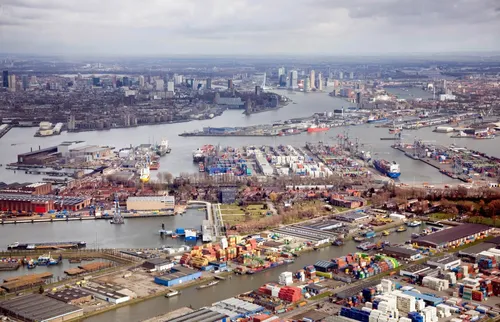
In Rotterdam, many of the city’s circular efforts have to do with the port and the industries in the port area. These industries, together with the logistics involved, use enormous amounts of energy and resources and cause a range of residuals. The Rotterdam Makers District is an area within the port that houses circular companies such as Umincorp, GroenCcllect and Royal 3D.
When it comes to circularity in the port cluster, challenges and opportunities can be found in chemical recycling, large scale waste processing and biofuels. In these areas, Rotterdam’s circularity efforts are aligned with regional policies and programs, such as Cluster Energiestrategie Rotterdam-Moerdijk and the Circulaire Actieagenda Zuid-Holland.
The Port of Rotterdam Authority is actively working together with many regional and chain partners to develop new, circular value chains, for example around the chemical recycling of plastics and the reuse and recycling of batteries. This is creating lots of opportunities for businesses to connect to existing developments or to design and develop new activities and solutions.
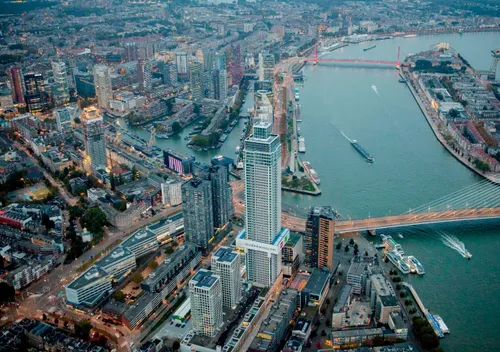
Photo: many of the current circularity efforts in Rotterdam have to do with the port and the industrial cluster.
Circularity projects in the port cluster
Some examples of current and future circularity projects and investments in Rotterdam’s port and industrial cluster:
Waste-2-Jet
Collaboration for production of biofuels from waste materials.
Buurman Rotterdam
Located in the Rotterdam Makers District. Local reuse of materials, including a wood workshop and shop for reclaimed building and other materials.
Neste
Expanding production capacity for sustainable fuels and raw materials for chemical industry.
REKO
Thermal cleaning, separating/washing solids from waste water or other fluids.
TES
Investing in battery recycling facility.
PlantOne
Test and production facility for sustainable and circular innovations.
Shell
Building a new biofuel plant (820,000 tons/year) at Shell Pernis.
Xycle
Building a plant for converting non-mechanical plastic waste to high-quality sustainable raw m
BlueCity: icon of the circular economy
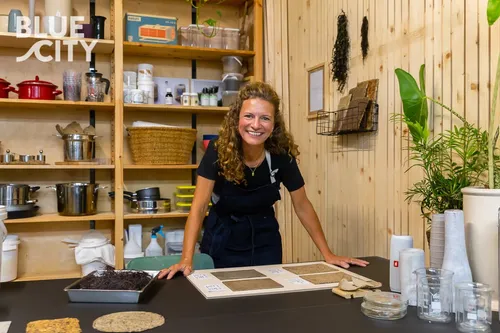
If you say ‘circularity’ in Rotterdam, you say BlueCity. Located in the city centre and overlooking the river Meuse, this former tropical swimming oasis is now an international icon of circular economy, a national platform for circular entrepreneurs, and a very visible local accelerator that empowers circular entrepreneurs and inspires citizens. At BlueCity, innovative, sustainable and circular entrepreneurs are not only talking the talk, but walking the walk and linking their waste streams. Inside the BlueCity ecosystem, waste streams are valuable building blocks; the output of one is the input for the other. This way creating a much needed and inspiring example for the circular economy. BlueCity is an independent platform for the city of Rotterdam, its entrepreneurs and its inhabitants, aiming to stimulate entrepreneurship and to contribute to the innovative culture in Rotterdam. Entrepreneurs located here include Better Future Factory, FruitLeather Rotterdam, Rotterzwam, Alga.Farm, BlueBlocks and Vibers.
Photo: BlueBlocks (research, circular design and local collaborations for new sustainable living concepts and zero waste eco-systems) is located at BlueCity.
Projects and initiatives throughout the city
The port area and BlueCity may be the main hotspots for many circularity developments, but many more exciting companies, projects, initiatives, big and small, can be found throughout the city. We name but a few (some of these websites are in Dutch):
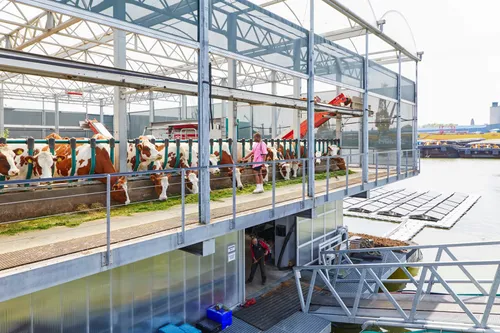
Floating Farm Rotterdam
‘Transfarmation’ via a circular, fully operational floating farm.
Innocent
Redesigning the plastic bottles for their juicy drinks.
Biotisk
Collecting and trading used cooking oils as raw material for biofuels.
PieterPot
Striving towards a world without packaging and waste-free shopping.
ByeWaste
Collecting discarded products at home and giving them a second life.
Pryme
Transforming plastic waste in valuable products through chemical recycling.
The Soft City
Wool from Rotterdam’s grazing sheep: waste material turned into sustainable clothing.
Photo: The world’s first fully operational Floating Farm is located at Rotterdam’s Merwehaven.
Team Invest
For information about setting up or expanding your business in Rotterdam, please reach out to us: