Resilient Rotterdam: the sustainable and inclusive city
This is how things are done in Rotterdam: we collaborate, innovate, and find new ways to tackle today’s and tomorrow’s challenges. From climate change adaptation and the energy transition to digitalisation and inclusive growth, Rotterdam is a resilient city, with sustainability and inclusivity at its core.
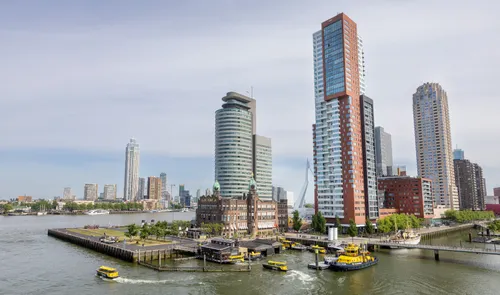
Resilience is rooted in Rotterdam’s history
Rotterdam distinguishes itself from its neighbours, more urban, more contemporary, more daring. What took hundreds of years to create, was wiped away in 15 minutes during WWII. And yet, its spirit of resilience transformed loss into action: to rebuild, reinvent, and shape the city of the future. This drive sparked a culture of experimentation. Today, ranked as the world’s 2nd most sustainable city, Rotterdam remains true to its DNA: Bold. Forward. Culture.
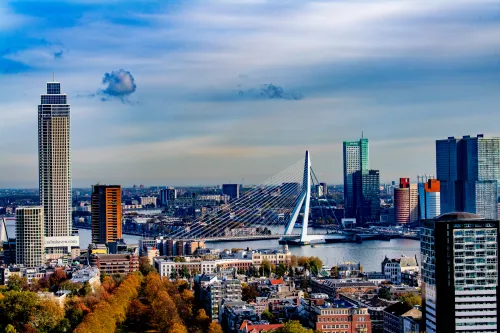
Convergence
Rotterdam achieves resilience through the convergence of innovation, sustainability and inclusivity. Through the Convergence alliance, Erasmus University, Erasmus MC, and TU Delft unite expertise in health, data, and technology to address today’s most urgent challenges.
The city also leads globally in sustainability:
- Home to the UN Global Centre of Excellence on Climate Adaptation.
- A member of the C40, Clinton Climate Initiative, 100 Resilient Cities, and Connecting Delta Cities.
- Committed to becoming climate-neutral and fully circular by 2050.
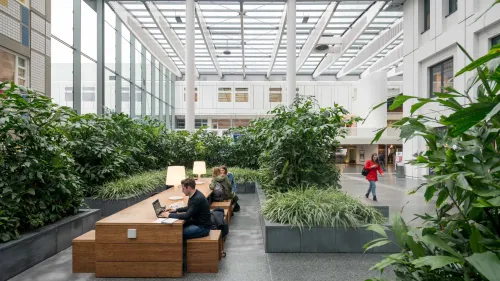
Legacy through collaboration
Rotterdam ensures events leave a positive legacy. The Rotterdam Collaboration for Change framework connects congresses to local projects in sustainability, education, and inclusion. Examples include engaging youth in organ donation awareness or transforming playgrounds for community use.
Via the Rotterdam Collaboration for Change, Rotterdam Partners will support you to ensure your event means more than economic spinoff, and makes a lasting social and environmental impact.
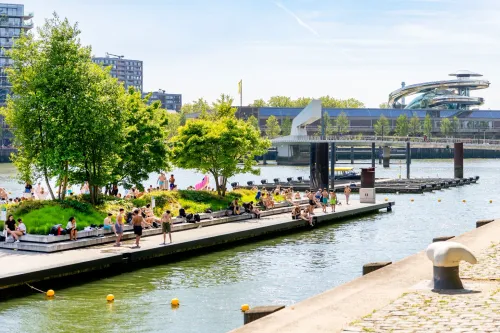
Green public transport & seamless accessibility
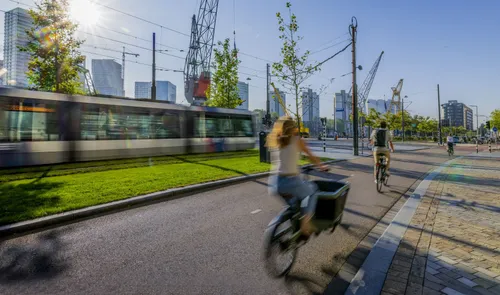
Rotterdam is ranked the #1 connected large European city and is participating in the SUM (Seamless Shared Urban Mobility) project, integrating shared mobility with public transport. This ensures global connectivity and eco-friendly transport that is easy and efficient:
- Compact, walkable, and bike-friendly city.
- 600 kilometers of bike lanes.
- Shared e-scooters powered by 100% renewable electricity.
- RET (local public transport company) aims for a fully electric fleet by 2030
Sustainable venues & hotels
The venues and hotels of Rotterdam are actively pursuing sustainable best practices, offering an innovative, eco-conscious experience for your event.
Sustainable practices in venue operations
Rotterdam’s venues and hotels integrate sustainable practices, from wastewater treatment and low-consumption systems to controlled-flow taps and underground water buffers, ensuring efficient water management across operations.Europe's first fossil-free convention centre
Rotterdam Ahoy Convention Centre (RACC), recognised as Europe’s 1st fossil-free ICC. Demonstrating its commitment to environmental responsibility with features like 5,000+ solar panels, an urban water buffer, and a 1,713 m² moss sedum roof that offsets CO2 and improves insulation.Hotel commitment across the city
By 2028, Rotterdam will offer over 12,000 hotel rooms with a strong sustainability focus, from repurposed eco-conscious designs to the citywide “Hotel Neutraal” initiative, uniting hotels and partners in a CO₂-neutral, circular future.Evolving client expectations and certifications
Sustainability has shifted from a “value add” to an essential in venue selection. Rotterdam’s venues and hotels meet this demand with certifications, policies, and sustainable practices that match delegate expectations.


